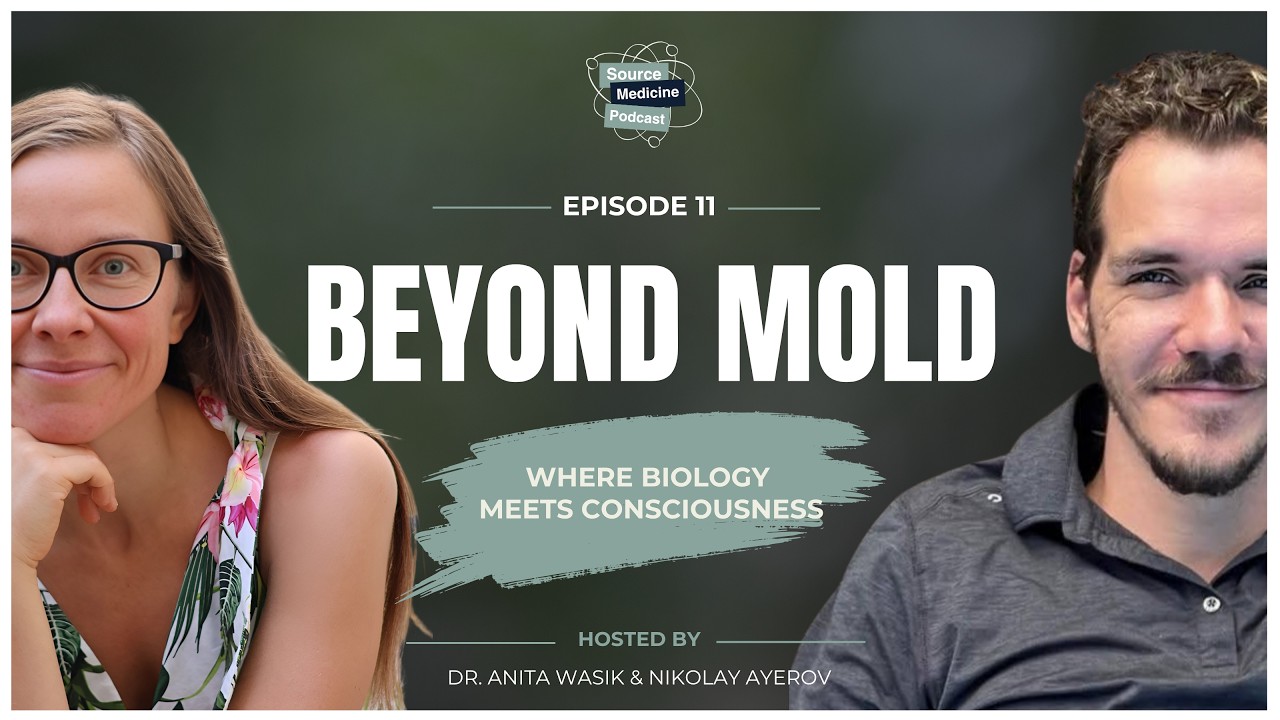
Episode 11
Beyond Mold: Where Biology Meets Consciousness
A careful look at mold that goes past the checklists, into the terrain, the environment, and the deeper conversation between biology and awareness.
1h 27m
Summary
Mold is real, and it can affect health significantly. It has also become a term used so loosely that the underlying biology often gets lost. This conversation begins with the science, how mold interacts with a body, what environments allow it to thrive, and how the nervous system responds, and then widens into a subtler question about the terrain a life is lived within.
We move slowly through the intersections of environment, physiology, and awareness. The intent is not to prescribe, but to describe: to give listeners a fuller picture from which to make their own informed choices.
By the end, mold becomes less of a villain and more of a signal, pointing toward the conditions of the spaces, and the states, we inhabit.
"Your environment is not around your biology, it is part of it."
Key Takeaways
- Environment is part of the body, biologically speaking.
- The nervous system reads spaces before the mind does.
- Terrain and sensitivity interact; both are worth understanding.
- Fear-driven protocols often outrun the evidence.
- Awareness of surroundings is a legitimate form of medicine.
The Origin Point Lens
A body is never separate from the room it is in. Mold is one of the clearest reminders that the environments we inhabit are quietly shaping our biology. Origin Point holds this as a wider principle: health is a relationship between an internal terrain and an external one. When we design our spaces, and our states, with more awareness, the body has less to defend against. The conversation about mold, at its deepest, is a conversation about the ecologies we live inside.
Continue Exploring
Continue with Episode 9 on viruses and Episode 8 on parasites for the full terrain-first arc.
Transcript
Related Episodes
More conversations exploring these same patterns will surface here.